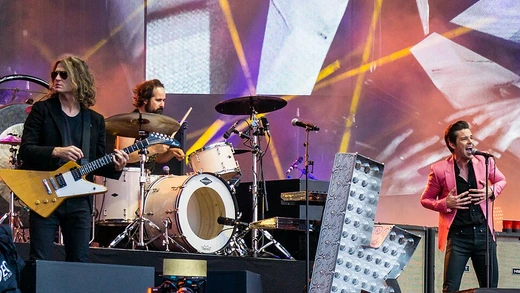
Wembley Stadium
Ninety thousand strangers become one congregation beneath the Arch, and the song takes over the sky.

Wembley Stadium is the colossal, arch-crowned arena in London, England, that stands as one of the most mythologised live-music destinations on the planet. For The Killers, the band from Las Vegas whose anthems like 'Mr. Brightside' became generational touchstones, Wembley represents the kind of monumental stage where a song written in a small Nevada bedroom suddenly roars out to nearly ninety thousand voices at once. It is less a venue than a rite of passage: the moment a band's sound stops being a recording and becomes a shared physical force.
In the broader story of the band's live career, Wembley occupies the position of a summit. Touring the UK is a tradition for American rock acts, and filling a stadium of this scale—under that unmistakable white arch—signals that the music has crossed from cult following to cultural event. Fans treat a Wembley ticket the way pilgrims treat a holy site: something to be earned, hoarded, and remembered for decades.
- Location
- London, England
- Approximate capacity
- 90,000
- Iconic landmark
- The Arch (a 133-metre steel and glass structure spanning the stadium)
- Current stadium opened
- 2007
- Role in The Killers' story
- Premier UK arena performance; a milestone in the band's live career
- Affiliation
- Independent venue; hosts football, concerts, and major sporting events
Lore & Background
The original Wembley Stadium opened in 1923 and became the spiritual home of English football and, later, of rock and pop spectacle. The old stadium's famous twin towers were demolished in the early 2000s, and the ground was rebuilt from the ground up, reopening in 2007 with a single, sweeping arch that replaced the old pair. The new structure is wider, more open, and engineered so that sound bounces off the bowl in a way that makes a full stadium feel like one enormous instrument.
For a band like The Killers—whose lyrics often orbit longing, small-town restlessness, and the ache of connection—Wembley is almost an ironic setting. Songs about motel rooms and desert highways suddenly detonate in a concrete-and-steel cathedral in the middle of London. The contrast is part of the magic: the intimacy of the writing colliding with the sheer scale of the delivery. When the band steps out and the first chord hits, the crowd's roar is not just noise; it is a physical pressure you feel in your chest.
There is a particular Wembley mythology that fans build around these nights. The arch becomes a symbol. The floodlights make the bowl look like the inside of a ship. And somewhere in the second half of the set, a song that started as a whispered confession in a bedroom becomes a wall of sound that swallows the city. That transformation—from private to collective—is the core of what Wembley means in the band's story.
In Their Own Story
The gates open at half past five and the air already smells of wet tarmac and cheap lager. You push through the turnstile with a wristband still damp from the rain, and the sound hits you before you even see the stage—a low, thrumming hum of ninety thousand people shifting their weight, calling out names, singing the words to a song they've known since they were sixteen. You find your spot in the lower tier, close enough to feel the bass in your molars. The lights go down. A single white beam finds the centre of the stage. Then the first strum, and the Arch above you seems to vibrate, and every stranger around you is suddenly singing the same line as you, and for three minutes and forty seconds, the whole bowl is one lung breathing in and out, and the city outside is just a rumour behind the glass.
Reader's Guide
You approach Wembley from the south and the Arch announces itself long before you reach the gates—a white, skeletal curve against the London sky, almost too clean to be real. The concourse is vast, tiled, and perpetually echoing. Security lines snake for twenty minutes. The air is thick with the smell of hot dogs and anticipation.
Inside, the bowl is a single, unbroken amphitheatre. There are no obstructing pillars, no upper-tier overhangs cutting off sightlines. The stage sits at one end, and the geometry funnels every sound toward the centre. When a band like The Killers takes that stage, the effect is less a concert and more a weather event. You feel the kick drum in your sternum. The crowd's roar registers as a pressure change, like an altitude shift.
The venue is controlled by a professional events operation; it is not owned by any single artist. But on the night of a major show, the band effectively commands the space. The lighting rig, the pyrotechnics, the set design—all of it is built for the specific acoustics of this bowl. The Arch becomes a backdrop, a halo, a silent witness.
Across a typical UK leg, Wembley is the final stop, the exclamation mark. The band has played smaller rooms, built the crowd song by song. Here, they simply release what has been building. The setlist is often the longest of the tour. Encores stretch. And when the last note fades, the silence that follows is the loudest thing in the building.
Did You Know?
- The current Wembley Stadium's single Arch is roughly 133 metres tall, replacing the old stadium's twin towers that served as a landmark for over eighty years.
- The bowl's design eliminates the need for internal support columns, giving every seat an unobstructed view of the stage—a feature that makes full-capacity shows feel like a single, unified organism.
- For American bands, a UK tour traditionally culminates in a London arena or stadium date, making Wembley the symbolic 'end of the road' for a European leg.
- The Killers' songwriting often centres on small, specific American imagery—desert highways, motel rooms, midwestern towns—which creates a striking contrast when those songs are performed to a London crowd of nearly ninet
More in World & Setting
Elsewhere in the The Killers universe
Spotted an error? Know more?
This is a living reference — every entry is fact-audited, and reader corrections feed straight into our audit queue. Suggest an edit · See this site's audit record