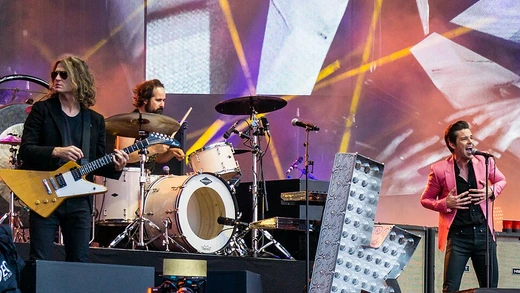
Red Rocks Amphitheatre
Where the earth built the stage and the sky built the roof.

Red Rocks Amphitheatre is a legendary outdoor concert venue nestled in the foothills of the Colorado Rockies, just outside Denver. In the broader landscape of The Killers' touring career and the wider rock-music world they inhabit, it stands as one of those rare stages where the architecture is not built but grown—massive red sandstone fins rising from the earth like the ribs of a buried titan, framing a stage that sits at their base.
For fans of The Killers and other artists who have played the venue, Red Rocks represents the ideal convergence of music and place: a setting where the acoustics are shaped by geology, the audience is cradled in natural tiers, and the sky above is an open canvas of Colorado light. It is a destination that turns a concert into a pilgrimage.
- Location
- Morrison, Colorado (Denver metro area)
- Type
- Outdoor amphitheater
- Setting
- Natural red sandstone rock formations in the Colorado Rockies foothills
- Primary use
- Live music and performance venue
- Geological origin
- Ancient lakebed sedimentary rock
- Atmosphere
- Open-air, mountain-adjacent, dramatic natural acoustics
Lore & Background
The red rocks themselves are the oldest part of the story. Formed from layers of ancient lakebed sediments deposited millions of years ago and then uplifted by tectonic forces, the fins of sandstone that define the venue carry a geological patience that no human-built stage can match. Their color shifts through the day—deep rust at dawn, blazing vermillion at midday, and a soft, almost translucent amber in the last hour before sunset. For a band like The Killers, whose aesthetic often plays with the contrast between neon-lit urban energy and something more elemental and vast, a venue like this is a natural home for the music's emotional range.
The amphitheater's design is essentially a collaboration between geology and engineering. The natural rock walls act as a partial acoustic reflector, giving the sound a warmth and depth that flat, open fields cannot replicate. The audience sits in a natural bowl, tiered by the slope of the hillside, so every seat feels close to the stage. There is no back wall of seats, no corporate signage, no glass barrier between performer and crowd. The horizon is mountains and sky. This matters narratively in the world of live music: it strips the performance back to its essentials—sound, light, and the shared breath of thousands of people in the dark.
In the canon of The Killers' live career, venues like Red Rocks occupy a special tier. They are not the intimate club show where a song is still being figured out, nor the stadium spectacle where the band is a dot on a massive stage. They are the middle ground where the music is fully realized, the audience is fully present, and the setting elevates the experience into something almost ceremonial. For a band that built its identity on the tension between the synthetic and the organic, the electronic and the human, playing beneath a sky framed by ancient stone is a kind of full-circle statement.
In Their Own Story
The last set is ending. Brandon's voice is a thread pulled taut against the silence of the crowd, and the red rocks behind the stage are glowing like embers in the dying light. The audience is a sea of upturned faces, phone lights flickering like a second, lower sky. Someone in the front row is singing every word, eyes closed, and the sound of their voice gets swallowed by the thousands around them until it is no longer one voice but the venue itself breathing. The final chord rings out and bounces off the sandstone, and for a moment the whole mountain seems to hum in sympathy. Then the lights go up, the rocks are just rocks again, and ten thousand people start the long walk down the hill toward their cars, carrying the echo in their chests like a second heartbeat.
Reader's Guide
You approach Red Rocks from the east, the highway threading through the foothills until the red stone appears on the ridge like a wound in the green. The parking lot is vast and flat, a human contrast to the organic chaos above. You walk up a switchback path, and the air gets cooler, drier, thinner. The first thing you notice is the color—not the flat red of a brick, but a layered, mineral red that shifts with the angle of the sun, streaked with white quartz veins and dark iron bands.
The stage sits at the base of the tallest fins, a modest platform dwarfed by the geology. The audience bowl is natural, sloping down and around the stage in a crescent. There are no walls, no ceiling. The sky is the ceiling. On a clear Colorado evening the stars come out with a clarity that feels almost aggressive, and the last light in the west paints the rocks in shades of apricot and rose.
Narratively, the venue functions as a threshold. It is where the urban, neon-soaked world of the band's home base—Las Vegas, its casinos, its artificial light—meets something older and more indifferent. The band plays, the crowd sways, and the rocks do not care. They have been here for millions of years and will be here after the last encore fades. That indifference is part of the magic: the music is temporary, the setting is not, and the contrast makes the night feel both urgent and eternal.
Across a touring career, the venue's role stays constant but the band's relationship to it evolves. Early shows carry a nervous, proving-themselves energy. Later shows carry the ease of a return visit, a homecoming to a place that is not their home but feels like it. The rocks do not change. The light does. The audience does. The music does.
Did You Know?
- The red sandstone fins at Red Rocks were formed from ancient lakebed sediments, meaning the venue is literally built on the floor of a prehistoric lake.
- The amphitheater's natural rock walls provide a partial acoustic reflector, giving performances a warmth and resonance that flat, open-air fields cannot replicate.
- The venue has no traditional back wall or ceiling; the audience's horizon is the open mountain sky, making weather and time of day central to every show's character.
- The color of the rocks shifts dramatically throughout the day, going from deep rust in early light to a translucent amber glow in the final minutes before sunset—a natural 'stage lighting' that no lighting rig can fully
More in World & Setting
Elsewhere in the The Killers universe
Spotted an error? Know more?
This is a living reference — every entry is fact-audited, and reader corrections feed straight into our audit queue. Suggest an edit · See this site's audit record