The Strip
Neon, desert, and the endless hum of a city that never quite sleeps.

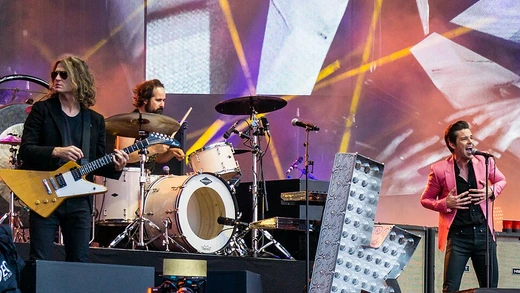
The Strip is the glittering, neon-drenched boulevard that runs through the heart of Las Vegas, Nevada, and it serves as the geographic and emotional home of the band The Killers. Formed in the mid-1990s in that very city, the group drew on the Strip's vast, electric, and often lonely landscape as a wellspring for their sound, imagery, and storytelling. In fan parlance, 'The Strip' is less a single street than a whole atmosphere: a world of towering hotel facades, after-hours casino floors, desert heat pressing against glass, and a perpetual sense of spectacle masking something quieter underneath.
As a setting in the Killers' creative universe, The Strip functions the way a city-state functions in a novel—it is where characters come from, where they perform, where they lose themselves, and where they try to find something real beneath the show. It is the backdrop against which the band's themes of excess, longing, faith, and reinvention play out.
- Location
- Las Vegas, Nevada, USA
- Associated act
- The Killers (formed in Las Vegas, mid-1990s)
- Role in the world
- Home city; primary creative and visual setting
- Sensory signature
- Neon light, desert heat, casino acoustics, nocturnal energy
- Narrative function
- Backdrop for themes of spectacle, loneliness, and reinvention
Lore & Background
The Strip in the Killers' world is not merely a road lined with hotels; it is a state of mind. The band grew up in the shadow of those enormous, glowing facades, and that proximity shaped their aesthetic in ways both obvious and subtle. The scale of the Strip—buildings that look like they were designed for a different, grander century, pools that stretch to the horizon, lobbies that swallow sound—gives the setting a quality of artificial grandeur that fans often describe as beautiful and slightly alien at the same time. It is a place where everything is bigger than life, which makes the small, human moments inside it feel more fragile.
Within the band's body of work and the fan-imagined world it inspires, The Strip is a place of contrasts. There is the roar of the casino floor and the silence of a desert highway at 3 a.m. There is the spectacle of a headline act and the quiet of a musician walking home after the last set. The Strip does not judge; it simply glows, indifferent and eternal, while the people moving through it carry their own stories of ambition, faith, heartbreak, and second chances. Fans often treat the city as a character in its own right—a vast, warm, slightly cruel presence that shapes everyone who lives under its light.
What makes The Strip narratively significant in the Killers' world is its duality. It is simultaneously a place of ultimate performance and ultimate anonymity. You can be the center of a stadium-sized crowd one night and completely invisible the next. That tension—between being seen and being lost, between the show and the person behind it—is the emotional engine that drives much of what fans love about the band's connection to this place.
In Their Own Story
The bass player steps out of the back of the tour van onto the sidewalk, and the Strip hits him like a wall of color. Every hotel is screaming in light—magenta, gold, electric blue—stacked ten stories high and humming with the low thrum of air conditioning and slot machines. The air smells like hot asphalt and the faint sweetness of air-conditioned lobby air leaking out of a revolving door somewhere behind him. He walks. His shoes slap the concrete. A couple in matching sequined jackets argues softly near a fountain. A bellhop stacks luggage onto a cart with the mechanical patience of someone who has done this ten thousand times. He passes a window where a woman in a red dress is laughing at something on her phone, and for a second the whole Strip feels like it was built for just that one moment of joy. Then he keeps walking, and the neon swallows him, and the city goes on glowing, indifferent and magnificent, the way it always does.
Reader's Guide
You arrive at the Strip and the first thing you notice is the scale. The buildings are not tall; they are enormous, layered, decorated with enough light to illuminate a small country. The sidewalks are wide, the air is dry and warm even at night, and the sound is a constant low roar—HVAC systems, distant music, the clink of glasses, the murmur of ten thousand conversations overlapping.
Who controls it? In the fan-imagined world, no single person does. The Strip belongs to the performers, the tourists, the night-shift workers, the musicians loading out of their vans at 2 a.m. It is a shared space, democratic in its indifference. You can be a headliner or a busker, and the neon does not care.
Narratively, The Strip is where the Killers' world is born and where it keeps coming back to. It is the origin point, the home base, the place where the music was shaped by the specific quality of light in a Vegas hotel lobby at midnight. Across the band's career, the Strip shifts from a backdrop of youthful ambition to a more complex, bittersweet presence—the city you grew up in, the city you keep returning to, the city that is always a little bit more than the sum of its casinos.
If you are walking it for the first time, walk at night. The Strip at 4 a.m. is quieter, stranger, and closer to the emotional register the band has always reached for: beautiful, a little lonely, and glowing with a light that feels both welcoming and slightly unreal.
Did You Know?
- The Killers formed in Las Vegas in the mid-1990s, and the city's desert-meets-neon aesthetic has been a consistent visual and emotional thread through their entire career.
- The Strip's architecture—massive, ornate, deliberately anachronistic—gives the setting a quality fans often describe as 'beautifully artificial,' a contrast that mirrors the band's themes of spectacle vs. sincerity.
- Las Vegas's geography, with its proximity to open desert, means the Strip is essentially a corridor of light in a vast dark landscape, a visual metaphor the band's imagery frequently echoes.
- The city's culture of performance—where everyone is, in some sense, on stage—resonates with the band's own identity as performers who have spoken openly about the tension between the public show and the private self.
More in World & Setting
Elsewhere in the The Killers universe
Spotted an error? Know more?
This is a living reference — every entry is fact-audited, and reader corrections feed straight into our audit queue. Suggest an edit · See this site's audit record