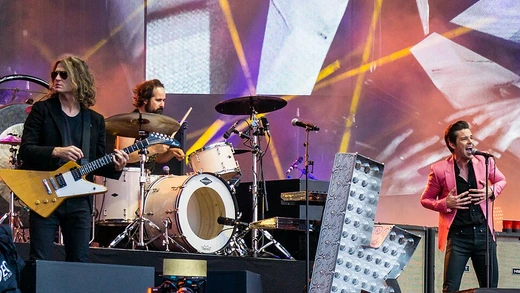
The Seventh Resonance
Seven notes, one frequency, and the silence that swallows everything after.

The Seventh Resonance is a legendary artifact-power hybrid at the heart of The Killers' mythic narrative. Described across the story as both a source of devastating creative force and a burden that reshapes those who carry it, it sits at the intersection of music, memory, and destruction. In the fan community it is treated as the symbolic keystone of the entire saga—the thing that separates a performer from a force of nature.
Its role in the broader story is that of a catalyst: characters orbit it, are drawn to it, or are shattered by proximity to it. It is never simply a tool; it is a relationship, a negotiation, and ultimately a choice about what one is willing to lose in order to make something that outlasts them.
- Type
- Artifact / Power
- Category
- Powers & Artifacts
- Affiliation
- The Killers narrative
- Status
- Central to the story's thematic core
Lore & Background
In the world of The Killers, the Seventh Resonance is never shown as a single physical object so much as a phenomenon that manifests through different vessels depending on who holds the story. Fans describe it as a frequency that lives in the space between intention and sound—a harmonic that, once struck, cannot be unstruck. The narrative treats it as ancient in the way that grief is ancient: not a thing that happened, but a thing that is always happening to the next person who reaches for it.
The story's characters do not 'use' the Seventh Resonance so much as survive it. Each encounter with the power strips away a layer of the self, leaving behind something rawer, louder, more honest. The lore suggests that the number seven is not arbitrary but structural: six resonances build, accumulate, and create, while the seventh is the release that undoes the builder. It is the note that ends the song and the one that makes the song matter.
What fans love most about the Seventh Resonance is its ambiguity. It is never fully explained, never reduced to a simple power-up or a villain's weapon. It resists systematization, which is precisely what makes it the emotional center of the saga. Every character who touches it is changed in a way the story never fully quantifies, leaving readers and listeners to feel the weight of it rather than measure it.
In Their Own Story
The stage was dark except for a single amber light cutting through the haze. She stood at the edge of the platform, fingers wrapped around the neck of the guitar like a lifeline, and felt the hum building in her sternum—not in her ears, not in her hands, but deep in the architecture of her ribs. The first six notes had been easy. They were just notes. But the seventh was different. The seventh was the one that remembered her name before she did.
She played it. The air in the venue didn't shake; it *listened*. Somewhere in the back row, a man set down his drink and wept without knowing why. The amp hummed a frequency that wasn't in the signal chain. The light above her flickered, steadied, and turned the color of old photographs.
When the last overtone faded, she was still standing. But the guitar was warm in a way wood shouldn't be, and her reflection in the dark screen behind her looked a half-second older than she felt. She unplugged, stepped off the stage, and walked into a night that smelled like rain on hot pavement. She did not look back at the guitar. You never do, after the seventh.
Reader's Guide
In plain terms, the Seventh Resonance is a narrative power that represents the ultimate creative and destructive act: the moment when making something true costs you a piece of yourself that cannot be recovered. It is not a spell, a weapon, or a gadget. It is a threshold.
The rules, as the story implies them, are simple and unforgiving. The resonance can only be triggered by genuine emotional commitment—performing, creating, or speaking with total honesty. Half-measures do not activate it. The cost is proportional to the depth of the feeling: the more real the expression, the more of the self is given over to the frequency. There is no cooldown, no safety valve. Once the seventh note is struck, the person is different. The story does not offer a reversal.
Who can use it? In the narrative, anyone who has something true to say and the courage to say it without armor. It is not limited by talent, status, or lineage. What it demands is vulnerability, and that is rarer than any superpower.
Narratively, the Seventh Resonance is what makes The Killers' story about more than spectacle. It symbolizes the cost of authenticity, the idea that the most powerful art is also the most expensive, and that the audience's catharsis is paid for in the creator's silence afterward. It is the story's argument that creation and destruction are the same gesture seen from different angles.
Did You Know?
- The number seven in the name is treated in the narrative as structural rather than decorative—six resonances build, and the seventh releases and undoes, mirroring the story's arc of accumulation followed by catharsis.
- Fans frequently note that the Seventh Resonance is never depicted as a single physical object; it manifests differently depending on the character and the medium, making it a thematic anchor rather than a plot device.
- The power's cost is framed as irreversible identity change rather than physical damage, which sets it apart from typical 'power with a price' tropes in fiction.
- The narrative deliberately withholds a full mechanical explanation, leaving the resonance to be understood through its emotional and sensory effects on characters rather than through a rulebook.
More in Powers & Artifacts
Elsewhere in the The Killers universe
Spotted an error? Know more?
This is a living reference — every entry is fact-audited, and reader corrections feed straight into our audit queue. Suggest an edit · See this site's audit record