Coachella Valley
Where the desert hums and the Killers turn the whole valley into a single, endless chorus.

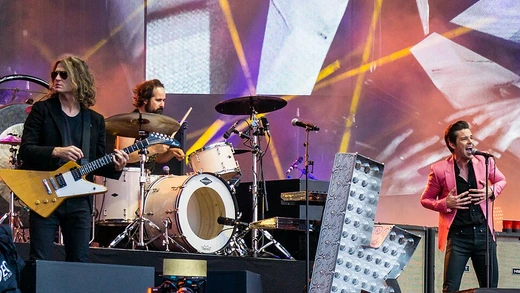
Coachella Valley is a sun-scorched, palm-fringed basin in southern California that occupies a special place in the visual and performative world of The Killers. While the band hails from the high desert of Las Vegas, the Coachella Valley—home of the Coachella Valley Music and Arts Festival—has become a recurring stage where their anthemic, stadium-sized sound meets a landscape of golden light, distant mountains, and open sky. For fans, it represents the intersection of the band's southwestern DNA and the ritual of live music in a place built for spectacle.
In fan-encyclopedia terms, Coachella Valley functions less as a plot location and more as a recurring 'world-state': the aesthetic backdrop against which The Killers' most cinematic moments unfold. It is where the desert mythology of their songwriting—dust, heat, neon on the horizon, a sense of vast empty space—gets translated into a real, walkable geography.
- Type
- Performance venue / Aesthetic setting
- Real-world location
- Riverside County, California, USA
- Associated act
- The Killers (origin: Las Vegas, Nevada)
- Cultural anchor
- Coachella Valley Music and Arts Festival
- Dominant aesthetic
- High-desert, sun-bleached, southwestern
- Narrative role
- Live-performance stage; fan-gathering landmark
Lore & Background
The Killers' sound was forged in the shadow of the Las Vegas Strip, where neon bleeds into the Mojave and the air shimmers with heat. The Coachella Valley, roughly two hundred miles to the south, carries that same DNA: dry wind, scrub brush, a sky so wide it feels like a ceiling painted by someone with too much gold leaf. When the band steps onto a Coachella stage, the geography is doing half the storytelling. The flat, open terrain means no walls, no corners to hide in—just the band, the crowd, and the endless horizon. It is the perfect physical match for songs that build from a whisper to a wall of guitars.
Fans often describe the Valley as a 'second home' for the Killers' aesthetic. The palm trees, the adobe-colored light at golden hour, the way the sun sets behind the San Jacinto Mountains—these images echo the visual language of the band's music videos and album art without a single lyric needing to be quoted. The desert is not just a backdrop; it is a character. It is patient, it is vast, and it makes every small human voice feel both insignificant and impossibly important, which is exactly the emotional register the band lives in.
Across the band's career, the Valley has served as a proving ground. It is where a new single is tested against tens of thousands of people who came specifically to feel the bass in their sternum. It is where the 'universe' of The Killers—part mythology, part live ritual, part shared fan memory—gets refreshed every spring.
In Their Own Story
The gates open at two, and the Valley is already a different place. The light has gone amber, the air tastes like warm dust and cheap beer, and somewhere in the back rows a kid is holding a hand-painted sign that says 'MR. BRIGHTSIDE OR I DIE.' The stage is a flat rectangle of black steel jutting out of the sand, and when the first chord hits—low, sustained, almost geological—the whole basin seems to inhale. Brandon's voice comes in like a radio signal from a desert town that doesn't exist anymore, and for four minutes nobody breathes. Then the chorus drops, the palms shake, and the San Jacintos glow pink behind the pyrotechnics, and you understand that this is not a concert. It is a small, temporary religion, and the Valley is its cathedral.
Reader's Guide
You arrive by a long, flat highway that cuts through nothing for miles. The Valley opens up slowly: first scrub, then a scattering of palms, then the festival grounds materialize like a mirage you decide to walk into. The light here is different from the coast—hard, direct, no diffusion. Shadows are sharp. Everything is outlined in gold after four in the afternoon.
The Killers' connection to this geography is not contractual; it is tonal. The band's sound was built for open spaces, for the kind of reverb you get when you shout in a dry canyon. The Valley gives them that. The flat terrain means the sound carries in a wide, even bowl rather than bouncing off walls. The crowd spreads out in every direction, and the band can see the whole thing, which changes how they play—bigger, more physical, less intimate.
Narratively, the Valley is a reset button. Whatever the band has been doing in the months before—studio work, touring, personal turbulence—the Coachella set is where they re-anchor. Fans treat it as a seasonal rite: the desert calls them back, they answer, and for one night the whole basin belongs to a single chord progression. Across the years, the staging evolves, the setlist rotates, but the fundamental geometry stays the same: flat land, wide sky, and a band that sounds like it was mixed inside a cistern.
Did You Know?
- The Killers formed in Las Vegas, a city embedded in the same high-desert ecosystem that defines the Coachella Valley's visual identity—dry heat, wide skies, and a landscape that feels deliberately sparse.
- The Coachella Valley Music and Arts Festival has become one of the most photographed music events in the world, and The Killers' performances there are frequently cited by fans as some of the band's most visually iconic
- The band's songwriting frequently evokes desert and southwestern imagery—heat, dust, neon, open roads—making the Coachella Valley feel less like a random venue and more like a natural extension of their lyrical world.
- The flat, open topography of the Valley means that during a Killers set, the audience can see the San Jacinto Mountains glowing behind the stage, creating a natural 'backdrop' that no LED screen could replicate.
More in World & Setting
Elsewhere in the The Killers universe
Spotted an error? Know more?
This is a living reference — every entry is fact-audited, and reader corrections feed straight into our audit queue. Suggest an edit · See this site's audit record