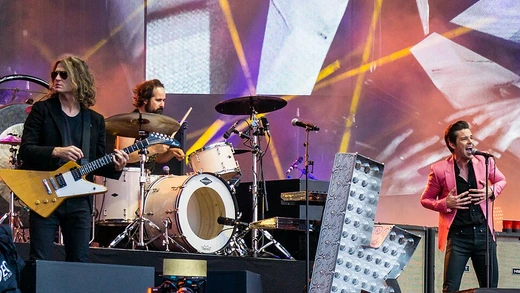
Madison Square Garden
Where the city performs its power and hides its price behind the curtain of the crowd.

Madison Square Garden is the towering, cathedral-like arena at the heart of the narrative's New York setting—a place where the city's rawest ambitions are staged for thousands of eyes. In the story, it functions less as a mere backdrop and more as a character: a site of spectacle, transaction, and consequence where the line between public performance and private violence blurs.
For the characters who move through its corridors, MSG is a threshold. What happens in the tunnels, the loading docks, and the VIP boxes behind the curtain of the crowd is where the real story is told. It is the one place in the city where power is performed, and where the cost of that performance is paid in silence.
- Type
- Indoor arena / multi-purpose venue
- Location
- Midtown Manhattan, New York City
- Narrative function
- Site of spectacle, transaction, and clandestine action
- Atmosphere
- Industrial grandeur; concrete, steel, and controlled chaos
- Access
- Multiple levels—public seating, backstage corridors, service tunnels, rooftop access
Lore & Background
In the narrative, Madison Square Garden is never merely a venue. It is the architectural embodiment of the story's central tension: the gap between what is shown and what is done. The arena's vast concrete bowl, its labyrinth of service corridors, and its layered verticality—rooftop, upper decks, floor level, basement loading bays—create a natural hierarchy of access that the characters exploit. Whoever controls a level controls the information that passes through it.
The story treats MSG as a place where deals are sealed not in boardrooms but in the fluorescent-lit back rooms, where the roar of the crowd above drowns out the quiet of a transaction below. The venue's identity as a site of mass spectacle makes it the perfect cover: no one questions movement through its arteries, no one watches the service elevators, and the sheer scale of the building means a person can vanish into its geometry as easily as into a crowd.
Across the arc of the story, MSG shifts from a symbol of legitimacy and public trust to a site of exposure. What begins as a stage for controlled performance becomes, by the story's later turns, the place where the performance collapses and the machinery behind it is revealed to those watching.
In Their Own Story
The lights are down. The crowd is gone. What remains is the smell of stale popcorn, the hum of HVAC systems cycling in the dark, and the echo of footsteps on polished concrete that no one is supposed to be walking on. He moves through the concourse with the easy confidence of someone who has done this before, past the concession stands with their half-empty syrup dispensers, past the security booth where the camera feed shows only the empty bowl of seats. Up the service stairwell. Past the loading dock where a truck idles with its tailgate down, engine ticking in the cold. The city hums beyond the glass. Somewhere above, the arena is dark and silent and waiting for tomorrow's show. But tonight, the real show is over, and the only audience left is the one that was never meant to see it.
Reader's Guide
Arrive from the street and the first thing you notice is scale. MSG is not a building you walk into; it is a building you walk under. The concrete facade is brutalist, unapologetic, and the entrance corridors feel like the throat of something vast. Inside, the geometry is all verticality—ramps spiraling up to upper decks, catwalks suspended over the floor, service shafts that drop into the basement like the roots of a tree.
Control here is layered. The public sees the arena; the staff sees the corridors; the people who matter see the rooms behind the rooms. The VIP boxes on the upper levels offer sightlines over everything, and in the narrative they function as the natural vantage point for those who are watching rather than being watched. The loading docks and basement levels are where the story's real work happens—unseen, unrecorded, and easy to deny.
What changes across the story is the relationship between the public face and the private machinery. Early on, MSG is a place of order, ticketed access, and controlled flow. By the later chapters, that order has been breached. The corridors that once moved people smoothly now carry secrets, and the crowd that once provided anonymity has become a witness. The arena does not change; the people moving through it do.
Did You Know?
- MSG's multi-level design—ranging from basement loading bays to rooftop access—creates a natural vertical hierarchy that the narrative exploits as a metaphor for power and access.
- In the story, the arena's identity as a mass-spectacle venue makes it the ideal cover for clandestine activity: the sheer volume of legitimate foot traffic means no one questions unusual movement.
- The VIP boxes on the upper decks are treated narratively as the natural 'control room'—the vantage point from which events below are observed rather than participated in.
- The story uses the contrast between the arena's public performance (lights, crowd, spectacle) and its private infrastructure (tunnels, service elevators, loading docks) as a recurring visual and thematic motif.
More in World & Setting
Elsewhere in the The Killers universe
Spotted an error? Know more?
This is a living reference — every entry is fact-audited, and reader corrections feed straight into our audit queue. Suggest an edit · See this site's audit record