The American Dream Unraveled
The dream was always a neon sign in a desert: bright, hollow, and built to be left behind.

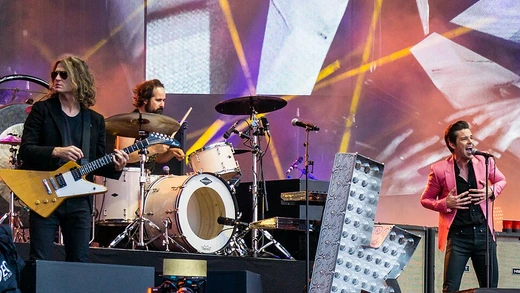
The American Dream Unraveled is a recurring thematic current running through The Killers' entire discography, from the debut album Hot Fuss (2004) through Imploding the Mirage (2021). Rather than celebrating the promise of upward mobility, self-reinvention, and small-town fulfillment, the band—rooted in the neon-and-dust landscape of Las Vegas, Nevada—consistently interrogates what that promise costs. The dream appears in their songs as a shimmering façade: a bar that never closes, a fairy tale that ends in sand, a man who must be something he is not.
This theme is not a single argument but a slow unraveling. Across albums, the band moves from longing (wanting the dream to be true) to disillusionment (watching it fail) to a weary, hard-won acceptance that the dream was always a story told by someone else. Brandon Flowers' lyrics, paired with the band's jangly, anthemic rock, create a specific emotional register: the feeling of standing in a wide-open desert where the horizon looks like freedom but is really just more emptiness.
- Band
- The Killers
- Origin
- Las Vegas, Nevada, USA
- Formed
- 2001
- Lead vocalist
- Brandon Flowers
- Debut album
- Hot Fuss (2004)
- Key thematic albums
- Sam's Town (2006), Day & Age (2008), Imploding the Mirage (2021)
- Band members (core four)
- Brandon Flowers, Dave Keuning, Mark Stoermer, Ronnie Vannucci Jr.
Lore & Background
The Killers emerged from Las Vegas, a city that is itself a monument to the American Dream's most extravagant and most hollow expressions. The band's early work in the early 2000s captured a specific post-9/11, post-Iraq-war American mood: the surface glittering while the foundation cracked. Songs like 'All These Things That I Will Do' and 'Read My Mind' from Hot Fuss frame the dream as a small-town promise—stay, commit, be enough—delivered in a city where staying is almost impossible and being enough is a performance.
By Sam's Town (2006), the dream had visibly frayed. The album's title references a real bar in Las Vegas, and its songs ('When You Were Young,' 'Bones,' 'For Reasons Unknown') treat the past as a place where the dream still worked and the present as a place where it has quietly stopped. The fairy-tale imagery of 'A Dustland Fairytale' is the clearest articulation: the narrative arc of American promise (rags to riches, love conquers all, hard work pays off) dissolves into the literal dust of the Nevada desert. The dream doesn't explode; it just dries out.
In later work, the unraveling becomes more personal and more political. 'Human' (Day & Age, 2008) channels the pressure to be extraordinary, to be the self-made American, and the exhaustion of that performance. 'Caution' (Pressure Machine, 2016) and 'Leave the World Behind' (same album) frame the dream as a trap you build around yourself. By Imploding the Mirage (2021), the dream is no longer something to be achieved or mourned; it is a mirage, and the album's title is an act of willfully watching it collapse. The band's Las Vegas origin is not a backdrop but the argument: the American Dream, in their telling, was always a show designed to distract you from the fact that you are standing in a desert.
In Their Own Story
The bar is called Sam's, and it's been called Sam's for forty years, though no one remembers a Sam. The jukebox plays a song about a man who promised to stay, and the man who promised is sitting in the corner booth, nursing a glass of something amber, watching the neon sign buzz and flicker outside the window. The sign says DREAM in letters that used to be gold and are now just yellow, the paint peeling in long strips like old bandages. A woman at the bar asks the bartender if the sign is coming down. The bartender says it's always coming down. They just fix it again. The man in the corner booth finishes his drink, leaves a five on the table, and walks out into the heat. The desert stretches in every direction, flat and silver under the sodium light, and somewhere out there a highway runs toward a city that promises everything and delivers a parking lot. He doesn't get in a car. He just stands there, in the middle of nothing, and watches the sign flicker until it goes dark, and then he walks home the long way, through the dust, past the motels with their faded curtains, past the casino where the slot machines are still clicking for no one, and the dream doesn't unravel so much as it simply stops being anyone's to hold.
Reader's Guide
The theme is The American Dream Unraveled, and it is the connective tissue of The Killers' entire catalogue.
It appears most concretely in 'All These Things That I Will Do' (Hot Fuss, 2004), where a narrator in a small town lists the things he will do to keep a relationship alive, and the weight of that list is the weight of a life with no exit ramp. The dream here is the promise that staying is enough, that commitment in a place with no horizon is a form of freedom. The song's quiet, almost whispered delivery undercuts the grandeur of the promise.
In 'A Dustland Fairytale' (Sam's Town, 2006), the dream is explicitly a fairy tale, and the setting is literal dust. The narrator watches the story he was told—love, growth, a happy ending—dry up in the Nevada heat. The title is the argument: the American narrative is a story that was always going to end in the desert, and the only honest thing is to watch it happen.
'Human' (Day & Age, 2008) shifts the dream inward. The pressure is no longer to build a life but to be a type: the self-made, extraordinary, unbreakable American. The chorus's repeated 'human' is a small, exhausted correction. You don't have to be the dream. You just have to be a person.
By 'Caution' (Pressure Machine, 2016) and 'Leave the World Behind' (same album), the dream is no longer something you chase; it is something that chases you, that builds walls around you, that tells you your self-destruction is your own fault. The song's argument is that the American narrative of individual responsibility is a cage, and the only honest response is to walk out of the frame entirely.
The story is not arguing that the dream is evil. It is arguing that the dream was never yours to keep. It was a sign on a highway, a neon word in a window, and the moment you stop looking at it, the desert is just the desert, and you are just a person, and that is enough.
Did You Know?
- The album title 'Sam's Town' (2006) is named after a real bar in Las Vegas, grounding the American Dream theme in a specific, unglamorous, working-class location rather than a skyline or a skyline.
- Brandon Flowers has spoken in interviews about growing up in Las Vegas and the specific feeling of a city built on spectacle and excess, which shaped the band's recurring tension between surface glamour and inner emptine
- The song 'A Dustland Fairytale' pairs the fairy-tale narrative structure (beginning, middle, happy ending) with the literal geography of the Nevada desert, making the American Dream's failure a matter of climate and terr
- The Killers' album Imploding the Mirage (2021) uses the word 'mirage' in its title, framing the American Dream not as a goal to be achieved but as an optical illusion that the listener is invited to watch collapse in rea
More in Themes & Motifs
Elsewhere in the The Killers universe
Spotted an error? Know more?
This is a living reference — every entry is fact-audited, and reader corrections feed straight into our audit queue. Suggest an edit · See this site's audit record