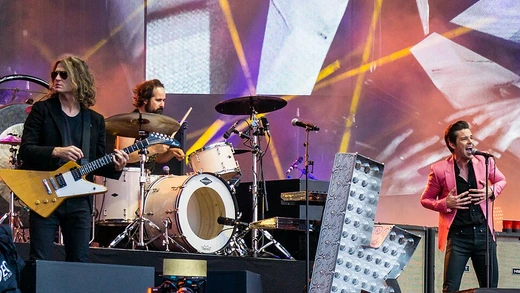
The Hollywood Bowl
Where the hills hold the sound and the sky becomes the ceiling for ten thousand voices.

The Hollywood Bowl is a legendary outdoor amphitheater nestled at the base of the Hollywood Hills in Los Angeles, California. In the sprawling touring narrative of The Killers, it stands as one of the most iconic stages the band has ever graced—a natural bowl of stone and earth where tens of thousands of fans gather under open sky to experience the full sonic weight of their live show. It represents the kind of grand, cinematic setting that elevates a concert into an event, a rite of passage for both the band and the audience.
As a venue, the Bowl has been a cornerstone of American live music since the late 1920s, hosting everything from symphonic performances to blockbuster rock tours. For The Killers, playing the Bowl is a marker of scale and prestige: a moment where their anthemic, arena-sized sound fills a natural landscape, and the city of Los Angeles becomes the backdrop for an evening that fans will remember for years.
- Location
- Elysian Valley, Los Angeles, California
- Type
- Outdoor amphitheater
- Opened
- 1929
- Approximate capacity
- 17,500
- Setting
- Base of the Hollywood Hills
- Role in The Killers' story
- Major touring destination and landmark live venue
Lore & Background
The Hollywood Bowl was conceived in the late 1920s as a civic amphitheater, carved into the natural topography of the Elysian Valley. Its tiered seating descends into a broad stone bowl, and the surrounding hillside acts as a massive natural reflector, giving the venue a warm, enveloping acoustics that no indoor arena can replicate. For nearly a century it has served as a stage for the Los Angeles Philharmonic, major touring orchestras, and—increasingly—rock and pop acts who want their shows to feel like open-air spectacles.
In the context of The Killers' career, the Bowl occupies a special place in the fan imagination. The band's live identity is built on widescreen production, wall-to-wall sound, and a setlist that moves from quiet, intimate moments to thunderous anthems. The Bowl's natural geometry amplifies that dynamic: the low register of the bass and drums rolls down the hillside, the synths shimmer against the open sky, and the crowd's collective voice becomes part of the mix. Fans who have been to a Killers show at the Bowl often describe it as the definitive version of the experience—the one where the production, the acoustics, and the setting all align.
The venue also carries a cultural weight that goes beyond the music. Los Angeles is a city of spectacle, and the Hollywood Hills behind the stage are a visual shorthand for that. When the band steps out onto the stage with the skyline and the darkening sky behind them, it becomes a tableau that feels almost cinematic, reinforcing the band's reputation for shows that are as much about atmosphere and image as they are about songs.
In Their Own Story
The last light is bleeding out over the hills. The crowd is a sea of upraised hands, phone screens flickering like fireflies in the amber dusk. The stage is a dark monolith at the bottom of the stone bowl, and you can hear the PA system humming, warming up, a low moan that vibrates in your sternum. Then the first chord hits—big, wide, almost orchestral—and the sound doesn't just reach you; it wraps around you, bounces off the hillside, and comes back a half-second later as a ghost. Someone next to you starts singing before the vocal even kicks in. The sky above is turning the deep violet of a bruise, and the Hollywood Hills are just a silhouette, a dark shape against the last gold. The band is a blur of motion under the stage lights, and the whole bowl is breathing in and out as one organism. For the next two hours, the city, the hills, the sky, and the sound are all one thing, and no one wants it to end.
Reader's Guide
Arriving at the Hollywood Bowl means entering a landscape that feels older and more grand than a typical concert venue. The walk up from the parking areas is a gentle climb through landscaped grounds, and the first sight of the tiered seating descending into the natural bowl is genuinely striking. The stone steps are worn smooth by decades of feet, and the hillside behind the stage is a wall of earth and scrub brush that catches the late-afternoon sun in warm, golden tones.
The space is controlled by a long institutional history—this is not a corporate arena with plastic seats and fluorescent lighting. It is a public amphitheater with a civic identity, and that shows in the architecture: broad stone retaining walls, open sightlines, no roof, no walls. The acoustics are the venue's true instrument, and the hillside reflector gives the sound a roundness and warmth that flat, indoor spaces simply cannot match.
Narratively, the Bowl sits at the intersection of LA's entertainment mythology and the live-music tradition. It is where the band's production design reaches its full scale—lighting rigs that stretch wide, video elements that play against the natural sky, and a sound system tuned to fill open air. Across a touring cycle, the Bowl show often lands in the latter half of a leg, when the setlist has been refined, the energy is dialed in, and the band is playing to a crowd that has been building anticipation for weeks.
By the final songs, the sky is fully dark, the hills are black shapes, and the only light is the stage and the ten thousand phone screens. The Bowl, in that moment, is less a venue and more a natural amphitheater where the city has gathered to witness something.
Did You Know?
- The Hollywood Bowl opened in 1929, making it nearly a century of live performance history before The Killers ever stepped on its stage.
- The natural hillside behind the stage acts as a large sound reflector, giving the venue a distinctive warm acoustics that differ markedly from indoor arenas.
- The Bowl is located in the Elysian Valley neighborhood, at the foot of the Hollywood Hills, placing it in one of the most visually iconic stretches of Los Angeles.
- The venue has hosted a wide range of performers over its history, from major symphony orchestras to large-scale rock and pop tours, making it a crossover space between classical and popular music traditions.
More in World & Setting
Elsewhere in the The Killers universe
Spotted an error? Know more?
This is a living reference — every entry is fact-audited, and reader corrections feed straight into our audit queue. Suggest an edit · See this site's audit record