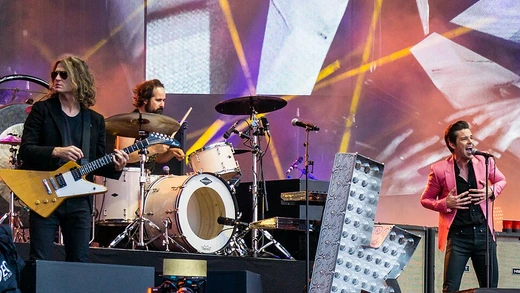
The Enforcers
The ones who keep the neon code sharp when the crowd forgets the rules.

In the fan-constructed mythology surrounding The Killers—the Las Vegas rock band led by Brandon Flowers—'The Enforcers' is a loosely defined faction fans have extrapolated from the group's recurring aesthetic of disciplined chaos, neon-soaked ritual, and the unwritten code of the nightlife world. They are not a character in a screenplay or a guild in a novel; rather, they are the symbolic 'enforcement arm' of the killer identity that the band's imagery, stagecraft, and lyrical themes evoke: the ones who keep the rules of the game sharp, who make sure the spectacle doesn't dissolve into mere noise.
As an unofficial fan-encyclopedia entry, this page treats The Enforcers as a narrative lens through which fans organize the band's visual language, touring mythology, and the almost liturgical seriousness with which the group approaches rock-and-roll performance. They represent the internal discipline that makes the flamboyance feel earned.
- Origin
- Fan-constructed concept drawn from The Killers' (band) aesthetic and lyrical themes
- Setting
- Las Vegas, Nevada / the broader rock-and-roll cultural landscape
- Associated band
- The Killers (formed 2001, Las Vegas)
- Frontman
- Brandon Flowers
- Core theme
- Disciplined spectacle; the code behind the chaos
- Status
- Unofficial fan-mythology construct; not a canon faction in any published narrative
Lore & Background
Fans who build mythology around The Killers often point to the band's insistence on precision within excess—tight four-piece instrumentation, meticulously choreographed stage presence, and a visual vocabulary borrowed from 1980s action cinema and Vegas strip spectacle. 'The Enforcers' crystallizes that tension: they are the unseen hands ensuring that the glitter is structural, not decorative. In fan writing, they are the ones who check the setlist, who make sure the tempo holds, who enforce the pact between performer and audience that makes a concert feel like a ceremony rather than a show.
The faction draws heavily on Las Vegas as a setting that is itself an enforced illusion—a city where every light, every smile, every deal is maintained by a hidden infrastructure of workers, technicians, and rule-keepers. Fans map The Enforcers onto that infrastructure: the people backstage, the road crew, the sound engineers, the security, the managers. They are the 'killers' in the sense of getting the job done without applause, without credit, without a name on the marquee.
Thematically, the concept also intersects with the band's lyrical preoccupations—obsession, duty, the cost of maintaining a persona. Songs that deal with watching someone else's life from the outside, with the pressure of expectation, with the thin line between performance and identity, all feed into the fan reading of The Enforcers as a kind of vigilante order bound by a code they did not write but will defend regardless.
In Their Own Story
The back-of-house corridor smells like solder and stale coffee. A road case thuds against the concrete. Somewhere above, the venue is still shaking with the last chord of the encore, the bass note pooling in the floorboards like water in a basin. The enforcer—no name, no face on the program—checks the cable runs one more time. Clips them. Taps the patch bay. The neon sign outside the loading dock buzzes its pink hum against the desert dark. He pulls his jacket tighter, steps out into the heat, and walks toward the van. The crowd is already gone. The code holds. It always holds. That's the whole job: make sure the light doesn't flicker, make sure the next city gets the same clean, sharp, unapologetic sound. No one will ever know his name. That's the point. That's always been the point.
Reader's Guide
At its core, The Enforcers in fan mythology represent the discipline underneath The Killers' spectacle. Their public face is the band's own: four-piece precision, a visual identity steeped in 80s action-film styling and Vegas neon, a sound that is both pop-polished and rock-aggressive. Fans read the 'enforcer' role into every element that keeps that identity coherent—the tight arrangements, the consistent stagecraft, the refusal to let a show become sloppy.
Peel back a layer and the internal politics emerge as fan-interpretation: who enforces what, and at what cost. The frontman carries the public persona; the rhythm section carries the structural integrity. Fans sometimes frame the bass and drum roles as the 'enforcement' layer—keeping tempo, keeping the ground solid while the guitar and vocal lines reach and twist above. It's a reading, not a fact, but it resonates with how the band's songs are built.
In the larger power structure of rock-and-roll culture that the band inhabits, The Enforcers occupy the space between artist and audience. They are the ones who make the contract feel real. Rivalries in fan discourse tend to pit the 'enforcer' reading against a more chaotic, punk-adjacent interpretation of the band's energy—fans who see The Killers as controlled versus fans who see them as barely leashed. Shifting allegiances in the fan community often track with which album or era a person gravitates toward: the tighter, more produced work reads as 'enforcer' territory; the looser, more live-sounding material reads as the code bending.
Ultimately, the faction is a mirror. Fans project their own values—discipline, loyalty, the dignity of unseen labor—onto the band's mythology, and The Enforcers are where that projection lands.
Did You Know?
- The Killers' name has been explained by the band as a cultural and aesthetic identity rather than a literal one, drawing on the idea of being a 'killer' in the sense of delivering something sharp and memorable—fans exten
- The band's Las Vegas origin is central to their visual identity; the city's infrastructure of hidden workers, technicians, and rule-keepers behind the glitter is a natural metaphor fans use to describe the 'enforcer' rol
- The Killers' four-piece lineup (vocals, guitar, bass, drums) is deliberately lean, and fans often interpret the bass and drum roles as the structural 'enforcement' layer that keeps the more melodic elements grounded.
- Brandon Flowers has spoken publicly about the band's debt to 1980s pop and rock aesthetics, and fans read the action-film styling of their early visuals as a kind of 'code' or 'uniform' that the enforcer concept enforces
More in Factions & Groups
Elsewhere in the The Killers universe
Spotted an error? Know more?
This is a living reference — every entry is fact-audited, and reader corrections feed straight into our audit queue. Suggest an edit · See this site's audit record